
Best eSIM for the Philippines, ranked.
 By
Updated May, 2026
15 min read

The Philippines is 7,000-plus islands, so coverage depends entirely on which carrier your eSIM rides and where you are island-hopping.
This guide ranks eight travel eSIMs for the Philippines on price and the network each one uses, from Manila out to Boracay, Cebu, and Palawan.
Set it up before you fly, keep your home SIM in for calls, and clear NAIA already online.
The shortlist, at a glance
- eSIMply: competitive Philippines eSIM pricing from $2.95 for 1GB, with unlimited data plans from $9.95 for 3 days. Runs on Smart, Philippines’ largest carrier by coverage. See plans »
- Airalo: the widest Philippines eSIM plan range with 12 options from 1GB up to 50GB / 30 days at $48.00. Also routes through Smart.
- Nomad: flexible capped and unlimited data plans, with unlimited options from $18.00 for 5 days. Good fit for island-hopping stays of a week or more.
All eight Philippines eSIM data plans, compared.
All eight side by side: the entry price, the plan range, and the Philippine carrier each one names. Entry pricing runs from $2.95 to $9.77 at the 1GB tier.
| Provider | Plan range | From | Network |
|---|---|---|---|
| eSIMply Cheapest overall. Up to 59% off RRP. Unlimited from $9.95. | 1GB to 20GB + Unlimited · 3–30d | $2.951GB / 7d | Smart (verified) |
| Airalo Widest range. 50GB / 30d for $48. Smart-verified. | 1GB to 50GB · 3–30d | $4.001GB / 3d | Smart (verified) |
| Saily NordVPN-backed. Clean app. 20GB / 30d for $29.99. | 1GB to 20GB · 7–30d | $3.991GB / 7d | Not disclosed |
| Nomad Unlimited from $18 / 5d. Capped up to 50GB / 30d. | 1GB to 50GB + Unlimited · 7–45d | $4.001GB / 7d | Not disclosed |
| Jetpac Entry at $4 / 1GB / 4d. Note: 20GB plan priced above 30GB. | 1GB to 30GB · 4–30d | $4.001GB / 4d | Not disclosed |
| aloSIM Globe-verified network. LTE. 5GB / 30d for $12. | 1GB to 20GB · 7–30d | $4.501GB / 7d | Globe (verified, LTE) |
| Roamless 500MB free trial. 30-day plans only from $3.95. | 500MB free + 1GB to 20GB · 30d | $3.951GB / 30d | Not disclosed |
| GigSky 100MB free plan. Priciest entry at $9.77 / 1GB. | 100MB free + 1GB to 10GB · 7–30d | $9.771GB / 7d | Not disclosed |
Philippines eSIM vs a local SIM card: which should you get?
Local SIM cards from Smart and Globe are available at NAIA terminals, Cebu-Mactan Airport, and major malls across the country. Physical SIM cards from these carriers come with a starter data pack and provide a local Philippine phone number for calls and SMS.
The challenge is time. Airport SIM counters at NAIA have long queues during peak arrival periods. Registration requirements mean providing ID and personal details at the counter. A prepaid travel eSIM installs in under 2 minutes at home before you fly, and connects to the Smart or Globe network automatically when you land.
For most visitors traveling to the Philippines, a prepaid eSIM is faster to set up, often cheaper at comparable data tiers, and leaves your phone’s physical SIM slot free for a second SIM if you need one. The one advantage of a local SIM: it gives you a Philippine phone number for local calls.
The providers, ranked.
Ranked for a Philippines trip on price, plan flexibility, and whether the provider names its Philippine carrier.
eSIMply
Competitive Philippines eSIM pricing across every data tier, with unlimited plans from $9.95.
eSIMply offers the most competitive Philippines eSIM pricing on our list. At $2.95 for 1GB over 7 days, it undercuts every other provider at the entry tier. The 5GB / 30-day plan at $10.95 covers a standard island-hopping trip with room to spare.
The unlimited data plans start at $9.95 for 3 days, the lowest entry price for unlimited data on our Philippines list. That makes eSIMply the practical choice for a long weekend in Manila or Boracay where you want uncapped Maps, GCash, and Grab without thinking about data limits.
eSIMply routes through Smart, the Philippines’ largest carrier by network coverage. Smart has strong 4G LTE coverage across Metro Manila, Cebu, Davao, Boracay, and the main tourist corridors. No ID or KYC required to activate.
Philippines plans
| Plan | Validity | Price | Savings |
|---|---|---|---|
| 1 GB | 7 days | $2.95 | Save $4.25 (59%) |
| 2 GB | 15 days | $4.95 | Save $6.75 (58%) |
| 3 GB | 30 days | $6.95 | Save $8.35 (55%) |
| 5 GB Best value | 30 days | $10.95 | Save $10.65 (49%) |
| 10 GB | 30 days | $17.95 | Save $17.15 (49%) |
| 20 GB | 30 days | $28.95 | Save $25.05 (46%) |
| Unlimited | 3 days | $9.95 | Save $10.75 (52%) |
| Unlimited | 5 days | $17.95 | Save $17.15 (49%) |
| Unlimited | 7 days | $25.95 | Save $22.65 (47%) |
| Unlimited | 10 days | $33.95 | Save $29.05 (46%) |
| Unlimited | 15 days | $47.95 | Save $40.25 (46%) |
| Unlimited | 30 days | $70.95 | Save $59.55 (46%) |
Installation
Buy online, get the QR code by email, and scan it into your settings before you fly; under two minutes. Set it as the active data line before boarding and it connects to Smart the moment you land at NAIA, Cebu, or Clark. No registration, no ID.
What works
- Cheapest Philippines eSIM on our list, from $2.95 for 1GB and $9.95 for 3-day unlimited
- Routes through Smart, Philippines’ widest-coverage carrier, verified from the product page
- No KYC and no ID required to activate, unlike a local Smart or Globe SIM card
- QR code emailed instantly after ordering, installs in under 2 minutes
- Up to 59% off RRP across the full plan range, including unlimited tiers
Trade-offs
- Data-only plan: no local Philippine phone number or inbound calls on the eSIM line
- Smart coverage drops on remote outer islands; no eSIM can fix dead zones beyond tower range
Airalo
Widest plan range on our list, with verified Smart network routing and large data buckets up to 50GB.
Airalo is the most widely recognised travel eSIM provider globally. For the Philippines, their plans route through Smart, confirmed on the Airalo product page. That means the same network as eSIMply, with coverage across Manila, Cebu, Davao, Boracay, and the main island corridors.
The plan range is the widest on our list, with 12 options from 1GB / 3 days up to 50GB / 30 days at $48.00. The 50GB / 30-day plan is useful for travellers spending a month across multiple islands who want one large bucket rather than buying multiple plans.
There is no unlimited data option for the Philippines on Airalo. For heavy daily data users who want uncapped access, eSIMply’s unlimited plans are the better route.
Philippines plans
| Plan | Validity | Price |
|---|---|---|
| 1 GB | 3 days | $4.00 |
| 3 GB | 3 days | $8.00 |
| 3 GB | 7 days | $8.50 |
| 5 GB | 7 days | $11.00 |
| 10 GB | 7 days | $18.00 |
| 5 GB | 15 days | $11.50 |
| 10 GB | 15 days | $18.50 |
| 20 GB | 15 days | $28.50 |
| 20 GB Best value | 30 days | $30.00 |
| 50 GB | 30 days | $48.00 |
Installation
The Airalo app guides you through installation step by step on iOS and Android. QR code install takes under 2 minutes. The app shows live data balance, which is useful when managing a capped plan across a multi-island trip.
What works
- Smart-verified network, same carrier as eSIMply, confirmed on Airalo’s product page
- 12 plan options from 1GB up to 50GB, widest range for the Philippines on our list
- Live data balance tracking in the Airalo app, useful across multi-island itineraries
Trade-offs
- No unlimited data option for the Philippines
- Entry-level pricing higher than eSIMply at every comparable data tier
Saily
NordVPN-backed eSIM with a clean plan lineup and competitive 1GB entry pricing at $3.99.
Saily is built by the NordVPN team, which gives it a trust signal that standalone eSIM brands don’t carry. For the Philippines, the 1GB / 7-day plan at $3.99 is a competitive entry price. eSIMply undercuts it at the same tier; Airalo’s 1GB option is more expensive at $4.00 over just 3 days.
The plan range runs from 1GB to 20GB with 5 options, all on 7-day or 30-day validity. The 10GB / 30 days at $18.99 is a solid mid-tier pick for a standard Philippines trip covering Manila, Cebu, and Palawan.
Saily does not disclose its Philippine carrier partner on the product page. The provider does not publicly name which local network the eSIM routes through. The Saily app tracks live data usage on iOS and Android.
Philippines plans
| Plan | Validity | Price |
|---|---|---|
| 1 GB | 7 days | $3.99 |
| 3 GB | 30 days | $7.99 |
| 10 GB Best value | 30 days | $18.99 |
| 20 GB | 30 days | $29.99 |
Installation
QR code install via the Saily app or directly from email. The app supports real-time data monitoring and lets you manage multiple eSIMs. Compatible with all eSIM-capable iPhones and Android devices.
What works
- NordVPN backing gives a trust signal that newer standalone eSIM brands lack
- Clean app with real-time data usage monitoring, easy to navigate
- Competitive 3GB / 30-day plan at $7.99, good value for shorter Philippines trips
Trade-offs
- Carrier not disclosed for the Philippines: you cannot verify which local network you’re on
- No unlimited data plans available for the Philippines
Nomad
Flexible mix of capped and unlimited data plans for the Philippines, including a 50GB / 30-day option.
Nomad offers one of the most flexible data packages for the Philippines. Their unlimited 5-day plan at $18.00 is a practical option for a Boracay or El Nido trip where you want uncapped data without a monthly commitment. The 10-day unlimited at $33.00 suits a two-week island-hopping itinerary. The Nomad eSIM app shows live data balance on iOS and Android.
On the capped side, the 10GB / 30-day plan at $13.00 is the most competitive large mid-bucket on our list. The 50GB / 30-day plan at $49.00 covers remote workers spending a month across multiple islands.
Nomad does not disclose the Philippine carrier on its product page. Note: the Holafly eSIM offers Philippines plans on a daily unlimited structure if you prefer that format, though it was excluded from our main comparison for that reason. The Nomad app shows live data balance on iOS and Android and does not auto-renew.
Philippines plans
| Plan | Validity | Price |
|---|---|---|
| 1 GB | 7 days | $4.00 |
| 3 GB | 30 days | $7.00 |
| 10 GB Best value | 30 days | $13.00 |
| 20 GB | 45 days | $23.00 |
| 50 GB | 30 days | $49.00 |
| Unlimited | 5 days | $18.00 |
| Unlimited | 10 days | $33.00 |
Installation
Standard QR code install. The Nomad app shows live data balance and remaining days. Set a reminder if your Philippines stay may extend beyond the plan window, as Nomad does not auto-renew.
What works
- 10GB / 30 days at $13.00 is the most competitive large mid-bucket on our Philippines list
- Unlimited from $18 / 5 days gives uncapped data for short island trips
- 20GB / 45 days is a unique long-validity option for extended Philippines stays
Trade-offs
- Carrier not disclosed: network quality unknown before purchase
- No auto-renew: manual top-up needed if your stay extends beyond the plan window
Jetpac
The Jetpac eSIM for the Philippines starts at $4 for 1GB over 4 days, with capped plans up to 30GB. Note a pricing anomaly at the 20GB tier.
Jetpac’s 1GB / 4-day plan at $4.00 is a reasonable entry option for a very short Philippines stopover. The 3GB / 7-day plan at $12.00 is mid-market for a week in Manila or Cebu City.
There is a notable pricing anomaly in the Jetpac Philippines range: the 20GB plan ($55.00) is more expensive than the 30GB plan ($44.99). If you need a large data bucket, the 30GB option is clearly the better buy.
Jetpac does not publicly disclose its Philippine carrier partner. There is no unlimited data option for the Philippines in the Jetpac lineup.
Philippines plans
| Plan | Validity | Price |
|---|---|---|
| 1 GB | 4 days | $4.00 |
| 3 GB | 7 days | $12.00 |
| 5 GB | 30 days | $19.00 |
| 10 GB | 30 days | $29.99 |
| 15 GB | 30 days | $31.99 |
| 30 GB Best value | 30 days | $44.99 |
| 20 GB | 30 days | $55.00 |
What works
- 30GB / 30 days at $44.99 undercuts Airalo’s 50GB plan for travellers who don’t need 50GB
- Short 4-day validity on the 1GB plan suits Manila stopovers without overpaying for 7-day plans
Trade-offs
- Pricing anomaly: the 20GB plan ($55) is more expensive than the 30GB plan ($44.99), so skip the 20GB tier
- Carrier not disclosed: you cannot verify which Philippine network you’ll connect to
aloSIM
Globe-verified routing with LTE. The only provider in our comparison disclosing a different local carrier from eSIMply and Airalo.
aloSIM is the only provider in our Philippines comparison disclosing a carrier that isn’t Smart. Their product page confirms Globe as the underlying network, with LTE speeds available. Globe and Smart are the Philippines’ two major carriers, with broadly comparable city coverage.
If you have a reason to prefer Globe over Smart (for example, you’re visiting an area with better Globe coverage, or a local contact recommends it), aloSIM is the only verified Globe option on our list.
Pricing is higher than eSIMply at every tier. The 5GB / 30-day plan at $12.00 is competitive but not the cheapest for the Philippines on our list. There is no unlimited data option.
Philippines plans
| Plan | Validity | Price |
|---|---|---|
| 1 GB | 7 days | $4.50 |
| 2 GB | 15 days | $7.00 |
| 5 GB Best value | 30 days | $12.00 |
| 10 GB | 30 days | $20.00 |
| 20 GB | 30 days | $30.00 |
What works
- Only Globe-verified provider on our list, confirmed on the aloSIM product page
- Useful if your itinerary includes areas with stronger Globe than Smart coverage
- Clean flat-rate pricing across all 30-day plans
Trade-offs
- Priced above eSIMply at every comparable data tier for the Philippines
- No unlimited data plan option available for the Philippines
Roamless
500MB free trial plan, with competitive 30-day capped pricing from $3.95.
Roamless offers a 500MB free trial plan for the Philippines, valid for 30 days. That’s enough to test the connection quality in your hotel or guesthouse before committing to a paid plan. The 1GB / 30-day paid plan at $3.95 is the second-cheapest entry on our list after eSIMply.
The constraint is validity. Every Roamless plan, including the free trial, is locked to 30 days. There is no option for a one-week city break or a short 4-day stopover. Roamless suits travellers spending two weeks or more in the Philippines who want 30-day capped pricing at a low rate.
Roamless does not disclose its Philippine carrier partner on the product page.
Philippines plans
| Plan | Validity | Price |
|---|---|---|
| 500 MB (free) | 30 days | $0 |
| 1 GB | 30 days | $3.95 |
| 2 GB | 30 days | $6.95 |
| 3 GB | 30 days | $7.95 |
| 5 GB Best value | 30 days | $10.95 |
| 10 GB | 30 days | $17.95 |
| 20 GB | 30 days | $27.95 |
What works
- Free 500MB trial lets you test connection quality before paying
- Competitive 30-day pricing: 5GB at $10.95 matches eSIMply at the same tier
Trade-offs
- 30-day validity only: no plan suits trips under two weeks
- Carrier not disclosed, so you cannot verify which Philippine network you’re connecting to
GigSky
100MB free trial plan. The most expensive paid entry on our list at $9.77 for 1GB.
GigSky offers a 100MB free plan for the Philippines, valid for 7 days. That is enough for a test connection or a very light day of navigation and messaging. Beyond the free tier, GigSky is the most expensive provider on our Philippines comparison by a significant margin.
The 1GB / 7-day plan at $9.77 is more than three times the price of eSIMply’s equivalent. The 10GB / 30-day plan at $72.74 is the highest-priced capped option on our list.
GigSky’s value case is long-validity plans across multiple countries on a single eSIM. For a Philippines-specific trip, the pricing is difficult to justify over the other options on our list.
Philippines plans
| Plan | Validity | Price |
|---|---|---|
| 100 MB (free) | 7 days | $0 |
| 1 GB | 7 days | $9.77 |
| 3 GB | 15 days | $25.49 |
| 5 GB Best value | 30 days | $38.79 |
| 10 GB | 30 days | $72.74 |
What works
- Free 100MB trial available for the Philippines, useful for testing network quality on arrival
- Multi-country eSIM works across 200+ destinations if the Philippines is one stop on a broader trip
Trade-offs
- Most expensive paid plans on our Philippines list by a wide margin at every tier
- Carrier not disclosed for the Philippines
Before you go to the Philippines.
A country of 7,641 islands where GCash moves faster than cash, Grab beats every taxi, and the biggest connectivity trap isn’t your eSIM plan. It’s the ferry crossing to your next island.
These are the things that catch first-time Philippines visitors off guard. Not the generic packing list, but the real practical stuff you need sorted before you board.
Signal disappears on inter-island ferries. Your eSIM cannot fix that.
Your eSIM delivers solid 4G in Metro Manila, Cebu City, Davao, and the main tourist town centres. The moment you board a ferry crossing the Sibuyan Sea, Visayan Sea, or Sulu Sea, signal drops to 2G or disappears entirely for stretches of 30 to 90 minutes. This is a tower-density issue, not an eSIM issue.
Download your offline Google Maps, accommodation address, tickets, and GCash QR codes before boarding any ferry. Remote island clusters like Batanes, Camotes, and Romblon have limited tower coverage. El Nido’s lagoon beaches on Tour A and B routes are off-grid by design.
GCash is the de facto national wallet, and tourists can now use it.
GCash dominates everyday payments across the Philippines, from sari-sari corner stores and wet markets to Jollibee, SM malls, and many beach resorts. Since 2023, GCash has allowed foreign visitors to register with a passport and a local Philippine number, including your eSIM number, creating a GCash Tourist account with a PHP 10,000 single-transaction limit and PHP 50,000 monthly cap.
Without a GCash account, you’ll be hunting for an ATM in places that don’t have one. GCash can be topped up at any 7-Eleven, Cebuana Lhuillier, M Lhuillier, or LBC branch nationwide.
PayMaya, now rebranded as Maya, is the second major e-wallet and works at most of the same QR-code merchants. Set it up as a backup for times when GCash servers go down, which happens during peak periods like payday weekends.
NAIA airport taxi scams are the most-reported first-impression trap.
Ninoy Aquino International Airport has a long-documented history of unlicensed “colorum” taxis touting in the arrivals hall. The standard approach involves a driver ignoring the meter and then demanding PHP 2,000 to 3,000 for a trip that should cost PHP 300 to 500. The Manila International Airport Authority (MIAA) advises passengers to use only accredited metered taxis with a yellow plate.
The simplest fix: walk past every person in arrivals offering you a ride and book Grab before you clear customs while still on arrival-hall Wi-Fi. You get an upfront fare, a named driver, and a tracked route.
Getting around and paying for things.
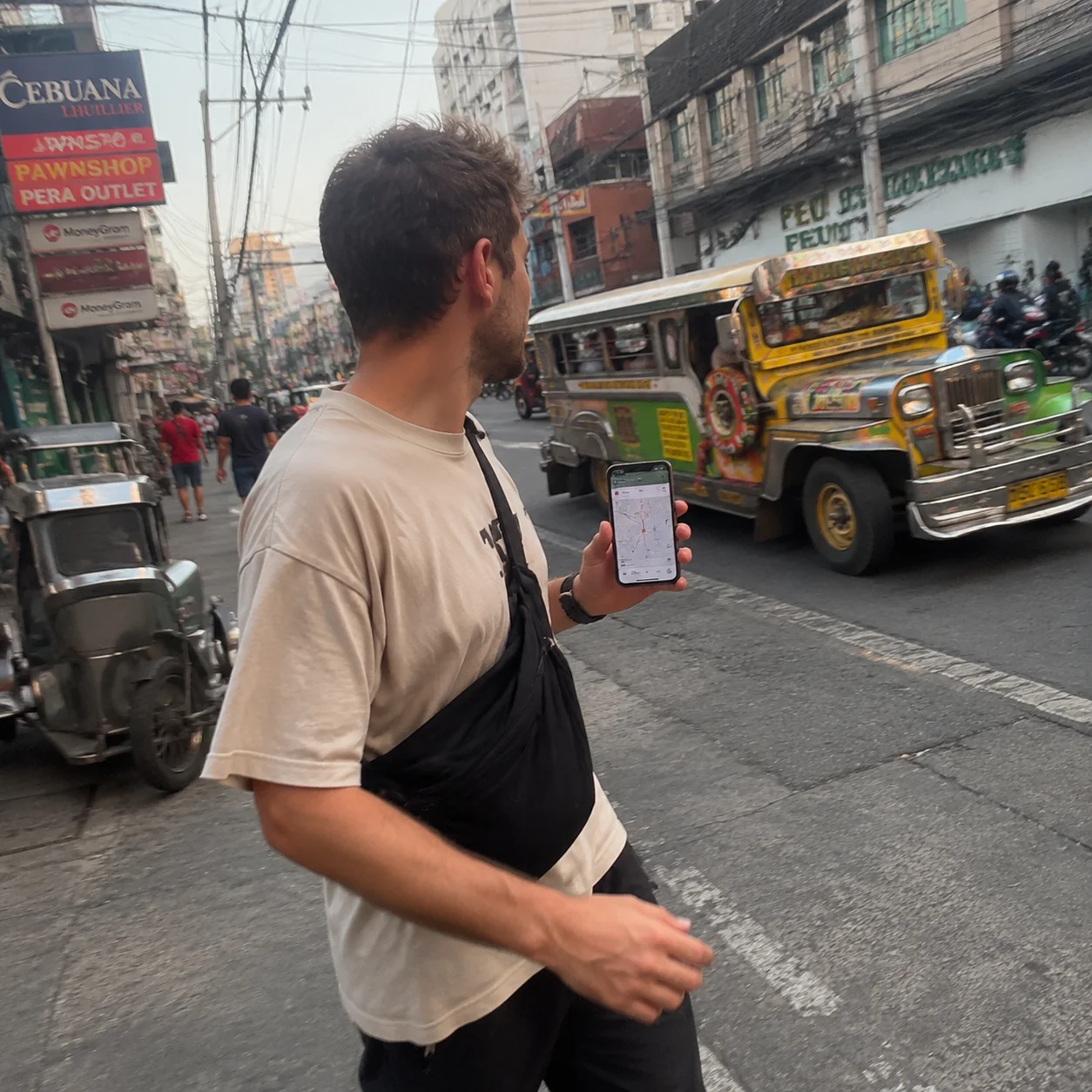
Use Grab for ride-hailing across Manila, Cebu, Davao, and Iloilo. Angkas and JoyRide for motorbike taxis in heavy Manila traffic. Sakay app for jeepney and UV Express routes (Google Maps doesn’t cover jeepneys). Beep card for MRT-3, LRT-1, and LRT-2 in Manila.
GCash is the dominant payment method across the country. Outside Metro Manila, Cebu, and Davao, cash is essential. Withdraw PHP 10,000 to 15,000 at a BDO or Metrobank ATM to minimise fees (PHP 200 per withdrawal). White-label ATMs in malls charge PHP 250 to 300 and offer worse rates. Carry PHP 1,000 to 2,000 at all times on island destinations.
The Beep card is the only sensible way to use Manila’s rail network.
Manila’s urban rail covers three lines: LRT-1 (Baclaran to Fernando Poe Jr. Station), LRT-2 (Recto to Masinag), and MRT-3 (North Avenue to Taft Avenue). The Beep card (PHP 100 purchase, PHP 20 load minimum) eliminates the token vending queue, which regularly breaks down during peak hours. Buy one at any rail station customer service window on day one. Load it with PHP 200 for a full day of Manila rail travel.
Angkas and JoyRide: motorbike taxis that beat Manila traffic.
Since the LTFRB’s 2022 regularisation of transport network vehicle services, Angkas and JoyRide offer metered motorbike taxi rides in Metro Manila and key regional cities. A Grab car across Makati in traffic can take 45 minutes; Angkas covers the same route in 12. Helmets are provided and legally required for passengers. Book through the app for upfront fares and driver ratings.
Island-hopping is booked locally, not through a global OTA.
Island-hopping tours in El Nido, Coron, and the Visayas are almost exclusively booked through local operators at the waterfront or via the barangay tourism office. Prices are standardised by local government for many routes: Tour A in El Nido is PHP 1,200 to 1,500 per person for a full-day shared boat. Klook and Viator charge a 30 to 50% markup for identical experiences. The Philippine Department of Tourism sets accreditation standards for operators.
Inter-island ferries: book 2GO and FastCat in advance.
Budget airlines (Cebu Pacific and AirAsia) link the major islands cheaply, but for routes like Manila to Puerto Galera, Cebu to Bohol, or Iloilo to Bacolod, passenger ferries are often the only practical option. 2GO Travel runs overnight routes on larger vessels; FastCat runs fast RoRo ferries on short inter-island crossings. Book online 24 to 48 hours ahead on busy routes. During Holy Week and Christmas, vessels fill weeks in advance.
Apps to install before you leave.
These are the apps travellers consistently say they wish they’d downloaded before landing in the Philippines. Not the generic ones, but the ones that actually solve problems once you’re navigating an unfamiliar island transport system on mobile data.
Most sit-down restaurants in Metro Manila, Cebu, and resort towns add a mandatory 10% service charge to the bill. That’s legally required to be shared among staff, so you have already tipped. No additional tip is obligatory. A voluntary PHP 20 to 50 cash tip for excellent service is appreciated. At casual eateries, carinderia, and street food stalls there is no service charge and no tipping expectation.
Cash remains essential outside Metro Manila, Cebu, and Davao. In island municipalities, beach barangays, and rural markets you will need Philippine pesos in hand. Withdraw PHP 10,000 to 15,000 at a BDO or Metrobank ATM (PHP 200 fee per transaction). White-label ATMs in malls charge PHP 250 to 300. The best exchange rates are at authorised money changers in SM and Ayala malls, not at airport counters.
Where you’ll actually use your eSIM in the Philippines.
Eight locations where your mobile data earns its keep. These are the places where coverage quality actually matters across your trip.
-
Metro Manila (NCR)Full 4G/5G coverage across Makati, BGC, Mandaluyong, and Quezon City on both Smart and Globe networks. Strong signal in all major malls, hotels, and transit hubs. Consistent data for Grab, GCash, and Sakay navigation throughout the city.
-
Cebu CityStrong 4G and emerging 5G in the business district, IT Park, and Mactan tourism corridor. Coverage drops in the mountainous Cebu province interior. Reliable in the city and along the coast.
-
Davao CityReliable 4G across the city centre. The best-covered city in Mindanao. Both Smart and Globe have dense tower networks. Good signal for navigation, Grab, and GCash across major commercial areas.
-
Boracay IslandStrong 4G island-wide along Station 1, 2, and 3. Dedicated tourism towers mean consistent speeds even during peak holiday season. One of the most reliably connected tourist islands in the country.
-
El Nido, PalawanGood 4G signal in El Nido town centre and the main beach road. Signal drops to 2G or disappears entirely on the island-hopping boat routes between lagoons. Download everything before boarding any boat.
-
Iloilo CitySolid 4G in the city proper and Iloilo Business Park area. Coverage thins quickly outside the city into Panay province. Good connectivity for the city’s growing culinary and heritage tourism circuit.
-
Bohol (Tagbilaran and Panglao Island)Reliable 4G at the Panglao resort corridor and Tagbilaran city. Inland Bohol including the Chocolate Hills viewing area has patchy signal between towers on the national road. Download Maps offline before heading inland.
-
Clark and Angeles City, PampangaConsistently good 4G at Clark International Airport and the main tourism strip. Useful transit hub for northern Luzon with reliable connectivity for onward planning and transfers.
How to choose the best eSIM for the Philippines.
This section pulls together information on the four key questions to ask before choosing between prepaid data plans for the Philippines. Activate your Philippines eSIM before boarding and you’ll be connected the moment you arrive in the Philippines.
To find the best eSIM for the Philippines, start with four practical questions. The Philippines is unlike most single-country trips: mobile data use when traveling in the Philippines from city to island is entirely different in Manila versus on a remote outer island. The right esim for your trip depends on which part of the country you’re visiting.
Whether you’re spending a long weekend in Manila, a week island-hopping through Palawan, or a month traveling Philippines from island to island, finding the best esim for traveling to the Philippines is about matching your plan to your itinerary. The esim options below cover every trip type, from a 1GB short-stay plan to 30-day unlimited data plans for digital nomads.
1. How much data does a Philippines trip use?
Most Philippines travellers use 1 to 2GB per day for standard use: Grab for transport, Google Maps for navigation, GCash for payments, WhatsApp, and social media browsing. Cebu Pacific for inter-island bookings uses very little data.
Remote workers on video calls or travellers uploading daily content should budget 3 to 5GB per day. A one-week trip to Manila and Cebu fits comfortably within a 10GB plan. Two weeks across multiple islands needs 15 to 20GB.
For island-hopping trips, remember that connectivity drops on boats and in remote barangays. On those days your data use will be near zero, which means your 30-day plan lasts longer than a comparable Europe trip where you’re consistently online.
2. Smart or Globe: which carrier does each Philippines eSIM use?
The network in the Philippines is split between two dominant carriers: Smart Communications (part of the PLDT Group) and Globe Telecom. Both have strong city coverage in Metro Manila, Cebu, and Davao. Coverage in the Philippines on rural outer islands differs by carrier and location.
Of the eight providers we reviewed, eSIMply and Airalo both publicly confirm Smart as their carrier in the Philippines. aloSIM publicly confirms Globe with LTE. The remaining five providers (Saily, Nomad, Jetpac, Roamless, GigSky) do not disclose their provider in the Philippines on the product page. Where a provider does not disclose, we say so rather than guess.
For most standard Philippines destinations, Smart and Globe offer comparable coverage in the Philippines. If you have a specific regional preference, verify with locals or tourism operators before choosing your right eSIM provider.
3. Capped plan or unlimited for island-hopping?
For a Philippines trip mixing cities with island travel, capped plans are often the more practical choice. On the days you’re crossing the Visayan Sea by ferry or hiking to a waterfall in Palawan, you’ll use very little data. On those days an unlimited plan provides no extra value.
Unlimited plans make clear sense for Manila-focused stays where you’re consistently online, or for Boracay where coverage is reliable island-wide. For a two-to-four-week mixed itinerary, a 10GB or 20GB capped plan that runs at full speed when signal exists is often the more efficient choice.
If you are a remote worker with predictable daily video call usage, eSIMply’s unlimited plans from $9.95 / 3 days or Nomad’s unlimited from $18.00 / 5 days eliminate the mental overhead of data tracking.
4. Philippines-specific eSIM or a regional Asia plan?
If the Philippines is your only destination, a Philippines-specific eSIM data plan is typically 20 to 35% cheaper than an equivalent regional Asia plan. Prices for Philippines-only plans from eSIMply start at $2.95, versus $5 or more for comparable regional Asia plans. You pay only for the Philippines without subsidising countries you won’t visit.
A Philippines eSIM as well as a regional Asia plan is available from most providers in our comparison. An eSIM for multiple countries makes financial sense when your trip also covers Thailand, Singapore, Japan, or Vietnam. Two or more countries tips the calculation in favour of regional coverage. Compare prices for both options before committing, as each provider offers the best value at different plan sizes.
Install your Philippines eSIM before you board and set it as your default data line. Turn off data roaming on your home SIM to avoid roaming charges. Download Google Maps offline for the Philippines before flying. Download GCash and set up your Tourist account at home using your passport. When you land at NAIA, you’ll have data, maps, and payments ready before you clear arrivals.
Philippines eSIM FAQs.
Can I get the best eSIM for Philippines before I arrive?
Yes, and this is the recommended approach. All eight providers in our comparison sell Philippines eSIM plans you can order, install, and set up from home before you fly. Use an eSIM by scanning the QR code in your phone Settings, then activate it before boarding. Purchasing an eSIM in advance is faster and usually cheaper than buying a local SIM card at the airport.
The process takes about 5 minutes: order an eSIM for the Philippines online, receive a QR code by email, and scan it in your phone’s Settings under “Add eSIM” or “Add Mobile Plan”. Set up your eSIM by setting it as your default data line before boarding. The whole process takes under 2 minutes once you have the QR code. A trip to the Philippines without mobile data from the moment you land is easily avoided this way.
When you arrive, whether at NAIA, Cebu-Mactan, Clark, or another Philippine airport, activate your eSIM by setting it as the default data line and you’ll have mobile internet access the moment you land. The Philippines as well as most Asian destinations have good Smart and Globe coverage in major arrival airports. No queue, no registration, no roaming charges on your home carrier.
What network does Airalo use in the Philippines?
The Airalo eSIM for Philippines routes through Smart, the Philippines’ largest carrier. This is confirmed on the Airalo product page, which lists Smart as the primary network. Smart has strong 4G LTE coverage across Metro Manila, Cebu, Davao, Boracay, and the main tourist island corridors. Of the eSIMs for the Philippines on our list, Airalo and eSIMply are both verified on Smart.
eSIMply also runs on Smart, confirmed on its Philippines product page. aloSIM is the only provider in our comparison confirmed on Globe. The remaining providers (Saily, Nomad, Jetpac, Roamless, GigSky) do not publicly disclose their Philippine carrier. Airalo doesn’t offer unlimited data plans for the Philippines, which is a consideration if you want uncapped data for a Manila or Boracay stay.
Is Airalo good for the Philippines?
Airalo is a reliable eSIM option for the Philippines. The Smart network routing is publicly verified, the app is well-designed, and the 12-plan range gives good esim options from 1GB up to 50GB / 30 days. Among the best eSIM providers available for the Philippines, Airalo sits near the top for plan breadth.
The main trade-off is pricing. eSIMply undercuts Airalo at every comparable data tier for the Philippines. eSIMply’s 1GB / 7-day plan is $2.95 versus Airalo’s 1GB / 3-day plan at $4.00 with a shorter validity window. If you want to buy the best eSIM purely on price for the Philippines, eSIMply offers lower rates at every tier.
For travellers buying eSIM plans across multiple countries in one place, Airalo’s platform breadth is a genuine advantage. Unlike other eSIM providers with narrower plan ranges, Airalo offers 12 Philippines options in a single account. For Philippines-specific value, eSIMply is the better deal.
How much data do I need for a trip to the Philippines?
For a standard Philippines trip, budget 1 to 2GB per day for normal tourist usage: Google Maps navigation, Grab bookings, GCash payments, WhatsApp, and browsing. Ferry days and remote island days will use much less. Travelers to the Philippines spending time on outer islands will find their average daily consumption is lower than on a city-focused trip in Europe or the US.
A 7-day trip to Manila and Boracay fits within a 5GB data plan for most visitors. Visiting the Philippines for 14 days across Manila, Cebu, and Palawan fits within 10GB to 15GB. Remote workers with daily video calls should budget 3 to 5GB per connected day. An eSIM for your trip covering two weeks needs at least 10GB if you’re staying connected in populated areas.
Parts of the Philippines with poor coverage, including outer island ferry routes, will use almost no data. If you’re uncertain about how much you’ll need, start with a 5GB or 10GB plan. You can always top up from within the provider app if you run low.
Can I use a Philippines eSIM in Boracay and Palawan?
Yes. Boracay has strong 4G coverage island-wide on both Smart and Globe networks, with dedicated towers serving the tourism corridor. You’ll stay connected in the Philippines across Station 1, 2, and 3 throughout your stay. Coverage in the Philippines on Boracay is among the most consistent of any island destination in the country.
Palawan coverage is more varied. El Nido town centre has good 4G on Smart and Globe. The island-hopping lagoon routes (Tour A and B) are off-grid by design, with no internet access during the boat passages between beaches. Coron town has decent 4G; the outer reef dive sites do not.
Download your offline Google Maps for Palawan before leaving El Nido town or Coron. Signal is not reliable once you’re on the water. This applies to eSIMs in the Philippines and local SIM cards equally: it’s a tower-density issue, not a provider issue.
Does a Philippines eSIM come with a phone number?
No. Travel eSIMs for the Philippines are data-only plans. They do not include a local Philippine telephone number or the ability to make or receive standard voice calls via the cellular network. The eSIM provides mobile broadband internet access only.
This is important to know about using an eSIM before you buy: it handles internet, not telephone calls. The correct setup is to keep your home SIM active in the same phone alongside your Philippines eSIM. Your home number stays active for calls, WhatsApp messages via mobile data, and 2FA codes. The Philippines eSIM handles all mobile data. Set it as your default data line and turn off data roaming on your home SIM.
Can I use my Philippines eSIM as a Wi-Fi hotspot?
Yes. All plans from all eight providers in our comparison include Wi-Fi hotspot and tethering as part of the eSIM service, at no extra cost. You can use your Philippines eSIM for data and share the connection with a laptop, tablet, or travel companion’s phone by enabling the personal hotspot in your phone’s settings.
If you want an eSIM with unlimited data for hotspot use, eSIMply’s unlimited data eSIMs start from $9.95 for 3 days and include tethering. Nomad also offers unlimited data eSIM plans from $18.00 for 5 days with hotspot included. Hotspot use burns through data faster than device-only use, so add 30 to 50% to your expected daily consumption when choosing a plan size.
Is my phone eSIM compatible for use in the Philippines?
Most phones from 2018 onward support eSIM. On iPhone, open Settings, General, About and look for “Available SIM” or “eSIM”; on Android, Settings, Network and Internet, SIMs, then “Add eSIM”. Once confirmed, you can buy and install in a couple of minutes from the QR code.
iPhones from XS onwards support eSIM. Samsung Galaxy S20 and newer support eSIM. Google Pixel 3 and newer support eSIM. All of these devices can activate an eSIM available in the Philippines from any of the eight providers in our comparison. If you’re travelling from the United States, some US carrier-locked phones need unlocking before a new eSIM will install. Contact your home carrier to confirm. Some phones sold in China are eSIM-incompatible even if the same model sold elsewhere supports it. Use a mobile app like Airalo or Saily to manage your eSIM after purchase, or simply get a new eSIM for a top-up if you run out of data mid-trip.
How we evaluated these Philippines eSIMs.
eSIMply is our own eSIM business, and one of the eight plans here is ours. We have written up the rest the way we would want a competitor to write about us, prices shown and carrier named where disclosed.
All eight sell a prepaid eSIM for the Philippines you can buy, install at home, and switch on when you arrive. The figures come straight from each provider’s own page.
Every claim in this guide traces back to a primary source: the provider’s own product page, the underlying Philippine mobile carrier (Smart Communications or Globe Telecom), the Philippines’ telecom regulator the National Telecommunications Commission (NTC), or the GSMA‘s eSIM technology and specification.
- For every provider, we visited the Philippines product page directly to identify the underlying carrier. eSIMply confirmed Smart. Airalo confirmed Smart. aloSIM confirmed Globe with LTE. The remaining five providers (Saily, Nomad, Jetpac, Roamless, GigSky) do not publicly disclose their Philippine carrier. We mark these as not disclosed rather than guessing.
- We compare pricing across the entire plan range, plan flexibility, validity windows, hotspot and tethering allowances, customer support availability, and free trial options where offered.
- Where two providers offer plans on the same Philippine network, we rank by price, plan flexibility, and install experience.
- We may earn a small commission if you buy through a link here. It does not change the order, and a weak provider stays off the list whatever the terms.
Jamie has worked in telecommunications for more than 8 years across mobile, SMS, eSIM, apps, and adjacent technology. He now writes for eSIMply as the tech content writer, analysing the top eSIM providers and breaking down what travellers actually need to know.
While we do our best to ensure accuracy, prices and plan availability are subject to change. Last updated by Jamie Cole, tech content writer at eSIMply.


