
Best eSIM for South Korea, ranked.
 By
Updated October, 2026
14 min read

South Korea has some of the fastest, most reliable mobile data on earth, so the real question is price and which carrier you land on, not coverage.
This guide ranks eight travel eSIMs for South Korea on what you pay and the network each one routes through, from Seoul out to the regional cities.
Set it up before you fly, keep your home SIM in for calls, and land at Incheon already online.
The shortlist, at a glance
- eSIMply: 1GB from $2.95 and unlimited plans from $10.95 on the SK Telecom network, with no ID required to activate. See plans »
- Jetpac: 1GB / 4 days for just $1.00, useful for a very short Seoul trip on SK Telecom or KT.
- Nomad: the only provider on our list to route across all three Korean carriers (SK Telecom, KT, and LG U+), with unlimited plans from $11.
All eight South Korea eSIM data plans, compared.
All eight side by side: the entry price and the Korean carrier each one names. SK Telecom, KT, and LG U+ all run nationwide 5G, so the carrier matters less here than the price.
| Provider | Plan range | From | Network |
|---|---|---|---|
| eSIMply Unlimited from $10.95. Up to 59% off RRP. | 1GB to 20GB + Unlimited · 3–30d | $2.951GB / 7d | SK Telecom |
| Airalo 12 plans from 1GB to 50GB. Two carrier options. | 1GB to 50GB · 3–30d | $4.001GB / 3d | KT / LG U+ |
| Saily NordVPN-backed. Unlimited / 15d at $48.99. | 1GB to Unlimited · 7–30d | $3.991GB / 7d | Network not disclosed |
| Nomad Covers all 3 Korean carriers. Unlimited from $11. | 1GB to 50GB + Unlimited · 7–30d | $4.001GB / 7d | SK Telecom / KT / LG U+ |
| Jetpac Cheapest entry on the list at $1.00 / 4d. | 1GB to Unlimited · 4–30d | $1.001GB / 4d | SK Telecom / KT |
| aloSIM Verified dual-carrier: KT and SK Telecom with 5G. | 1GB to 20GB · 7–30d | $4.501GB / 7d | KT / SK Telecom |
| Roamless 30-day plans only. SK Telecom and LG U+. | 1GB to 20GB · 30d only | $3.951GB / 30d | SK Telecom / LG U+ |
| GigSky Priciest entry. Auto-selects fastest network. | 1GB to 10GB · 7–30d | $4.991GB / 7d | Network not disclosed |
South Korea eSIM vs a local SIM card: which should you get?
A physical SIM card from a Korean carrier (SK Telecom, KT, or LG U+) is available at Incheon Airport telecom desks in the arrivals hall. It requires passport registration under Korean SIM registration law and costs more than most of the prepaid eSIM data plans on our list.
Airport SIM desk pricing typically starts at around 30,000–40,000 KRW (roughly $22–$30 USD) for a week of data, versus $2.95 for 1GB with eSIMply or $4.00 for 1GB with Airalo or Nomad.
A reliable eSIM also activates before you board, giving you mobile data the moment you land with no queue at the counter and no registration paperwork. For most visitors traveling to South Korea, a prepaid eSIM from an international service is faster, cheaper, and more flexible than buying a physical SIM card on arrival.
One advantage of a local SIM card: it includes a Korean phone number for local calls and SMS. A data-only eSIM does not provide one, though most travellers manage perfectly well with WhatsApp and KakaoTalk running over data.
One note from Reddit communities: some reservation systems (popular restaurant bookings via Naver or Kakao) require a Korean phone number to confirm a booking. A data-only eSIM won’t help there. For most travellers, this affects a small number of situations, but it is worth knowing before you land.
The providers, ranked.
Ranked for a South Korea trip on price, plan flexibility, and which Korean carrier each provider names. With three strong 5G networks, price tends to decide it.
eSIMply
South Korea plans from $2.95 for 1GB, with unlimited plans from $10.95.
eSIMply’s South Korea plans start at $2.95 for 1GB / 7 days, and unlimited data starts at $10.95 for 3 days. The eSIM runs on SK Telecom, listed as “SK” on every eSIMply Korea plan page. SK Telecom is one of South Korea’s three national carriers, alongside KT and LG U+.
eSIMply’s plan pages list speeds of 3G, 4G or 5G depending on the region. South Korea has some of the best mobile network infrastructure in the world, so the practical difference between SK Telecom and the other carriers is small for most city-based trips.
For a week in Seoul navigating by Naver Maps, running Papago for translations, and staying on KakaoTalk, the 5GB / 30-day plan at $9.95 covers a standard trip with plenty of headroom. Unlimited plans start at $10.95 for 3 days.
South Korea plans
| Plan | Validity | Price | Savings |
|---|---|---|---|
| 1 GB | 7 days | $2.95 | Save $4.25 (59%) |
| 2 GB | 15 days | $5.95 | Save $6.65 (53%) |
| 3 GB | 30 days | $7.95 | Save $8.25 (51%) |
| 5 GB Best value | 30 days | $9.95 | Save $9.85 (50%) |
| 10 GB | 30 days | $17.95 | Save $16.25 (48%) |
| 20 GB | 30 days | $28.95 | Save $25.05 (46%) |
| Unlimited | 3 days | $10.95 | Save $10.65 (49%) |
| Unlimited | 5 days | $18.95 | Save $17.05 (47%) |
| Unlimited | 7 days | $27.95 | Save $24.25 (46%) |
| Unlimited | 10 days | $33.95 | Save $29.05 (46%) |
| Unlimited | 15 days | $47.95 | Save $40.25 (46%) |
| Unlimited | 30 days | $67.95 | Save $56.25 (45%) |
Installation
Buy online, get the QR code by email, and scan it into your settings before you fly; under two minutes. Set it as the active data line before boarding and it connects to SK Telecom the moment you land at Incheon. No registration, no ID.
What works
- From $2.95 for 1GB / 7 days and $10.95 for 3 days of unlimited data
- Runs on SK Telecom, one of South Korea’s three major national carriers
- No KYC and no ID required to activate, unlike a local prepaid SIM card from an airport desk
- QR code emailed instantly after ordering, installs in under 2 minutes
- Plan only starts counting from the first data connection in South Korea, so you can buy weeks in advance
Trade-offs
- SK Telecom network only: no automatic failover to KT or LG U+ if SK Telecom signal is poor in a specific location
- Data-only plan with no local Korean phone number. Keep your home SIM for calls and WhatsApp.
Airalo
Two Korean carrier options: KT for fixed data, LG U+ for unlimited.
Airalo is the most widely used travel eSIM provider globally, and for South Korea it offers two distinct product lines: fixed-data plans routing through KT, and unlimited plans routing through LG U+. That is a genuinely useful split, since travellers who want a large capped bucket and travellers who want uncapped access are on different carrier products.
The fixed-data range runs from 1GB up to 50GB across plans from 3 to 30 days. The 50GB / 30-day plan at $49.00 is one of only two 50GB plans in our South Korea comparison. Nomad sells the other one for $39.00.
For Korea travel involving heavy data use, video calls, or extended stays, Airalo’s large-bucket options stand out. The Airalo app shows remaining data in real time, which helps manage a capped plan across a multi-week itinerary covering Seoul, Busan, and Jeju Island.
South Korea plans
| Plan | Validity | Price |
|---|---|---|
| 1 GB | 3 days | $4.00 |
| 3 GB | 7 days | $9.00 |
| 5 GB | 7 days | $10.00 |
| 10 GB | 15 days | $19.50 |
| 20 GB Best value | 30 days | $32.00 |
| 50 GB | 30 days | $49.00 |
What works
- Two distinct carrier options: KT for capped plans, LG U+ for unlimited, both verified on-page
- 50GB / 30 days at $49, one of only two 50GB plans in our South Korea comparison
- Airalo app shows real-time data balance, useful for multi-week Korea travel
Trade-offs
- Entry plans (1GB / 3 days at $4.00) cost more than eSIMply at the same data tier
- No single plan covers both large data buckets and long validity in one product
Saily
NordVPN-backed eSIM with a clean app and a competitive 1GB entry price.
Saily is built by the NordVPN team, which gives it a trust signal that standalone eSIM brands lack. Their 1GB / 7-day plan for South Korea costs $3.99, more than Jetpac ($1.00), eSIMply ($2.95) and Roamless ($3.95) charge for 1GB. The 5G connection is listed, though the specific Korean carrier is not disclosed on the product page.
The plan range covers the main data tiers from 1GB up to unlimited, with the unlimited / 15-day plan at $48.99 available for travellers wanting uncapped data. The Saily app shows live data balance on iOS and Android and has a clean interface that is straightforward to navigate.
Saily does not publicly disclose which of South Korea’s carriers (SK Telecom, KT, or LG U+) it routes through. The product page states “best networks” without naming a specific provider, so you cannot verify coverage before purchase beyond the 5G speed claim.
South Korea plans
| Plan | Validity | Price |
|---|---|---|
| 1 GB | 7 days | $3.99 |
| 3 GB | 30 days | $8.99 |
| 5 GB Best value | 30 days | $10.99 |
| 10 GB | 30 days | $18.99 |
| 20 GB | 30 days | $29.99 |
| Unlimited | 15 days | $48.99 |
What works
- NordVPN backing gives a trust signal that smaller eSIM brands lack
- Clean app with real-time data monitoring, straightforward plan management
- 5G connection listed for South Korea at a competitive 1GB entry price
Trade-offs
- Korean carrier not disclosed on the product page, so network quality cannot be verified before purchase
- Unlimited at $48.99 / 15 days is more expensive than eSIMply’s equivalent unlimited tier
Nomad
The only provider covering all three Korean carriers: SK Telecom, KT, and LG U+.
Nomad is the only provider in our South Korea comparison that publicly discloses routing across all three major Korean carriers: LG U+, SK Telecom, and KT. The exact carrier your eSIM connects to will depend on which network has the strongest signal at your location, which gives Nomad a structural coverage advantage in areas where one network is weaker than the others.
South Korea’s national coverage is excellent across all three carriers in cities and on the main KTX rail corridors. Where the multi-carrier approach matters most is in remote mountain hiking areas on Seoraksan, in deep valley trails in Gangwon Province, and on Jeju Island’s rural roads, where SK Telecom has a slight edge in coverage reach.
For unlimited data plans, Nomad’s 3-day unlimited at $11.00 and 7-day unlimited at $23.00 are competitive. The 50GB / 30-day plan at $39.00 is the best large-bucket price we found on a fully verified multi-carrier plan for South Korea.
South Korea plans
| Plan | Validity | Price |
|---|---|---|
| 1 GB | 7 days | $4.00 |
| 3 GB | 30 days | $8.00 |
| Unlimited | 3 days | $11.00 |
| Unlimited Best value | 7 days | $23.00 |
| 20 GB | 30 days | $25.00 |
| 50 GB | 30 days | $39.00 |
What works
- Only provider in our comparison routing across all three Korean carriers: SK Telecom, KT, and LG U+
- 50GB / 30 days at $39 is the best large-bucket price on a fully verified multi-carrier plan
- Unlimited plans from $11 / 3 days give uncapped Korea travel connectivity without daily caps
Trade-offs
- 1GB / 7-day entry plan at $4.00 is more expensive than eSIMply at the same tier
- No auto-renew: manual top-up needed if your Korea stay extends beyond the plan window
Jetpac
Lowest entry price on our list: 1GB over 4 days for just $1.00.
Jetpac has the most striking entry price in our South Korea comparison: 1GB for $1.00 over 4 days. For a traveller who just needs Maps and messaging for a quick Seoul stopover, this is a genuine deal. The carrier is verified as SK Telecom and KT, two of South Korea’s three major networks.
Beyond the entry plan, Jetpac’s 10GB / 30-day plan at $17.00 is competitive mid-tier pricing for South Korea. The unlimited / 10-day plan at $33.99 covers a week-plus trip for heavy data users. There are also some pricing quirks in the 20GB, 30GB, and 40GB range worth checking before you buy.
The Jetpac app manages your eSIM and data balance on both iOS and Android. Installing the eSIM follows the standard QR code process: scan the QR code in your phone’s settings and the eSIM installs in under 2 minutes.
South Korea plans
| Plan | Validity | Price |
|---|---|---|
| 1 GB Best value | 4 days | $1.00 |
| 3 GB | 7 days | $9.00 |
| 5 GB | 30 days | $11.00 |
| 10 GB | 30 days | $17.00 |
| 15 GB | 30 days | $22.50 |
| Unlimited | 10 days | $33.99 |
What works
- 1GB for $1.00 is the cheapest entry eSIM plan for South Korea on our list
- SK Telecom and KT verified on the product page, two of Korea’s three major 5G networks
- 10GB / 30 days at $17.00 is competitive mid-tier pricing for longer Korea stays
Trade-offs
- Pricing above 15GB gets less competitive than Nomad or Airalo at the same data tier
- No LG U+ coverage: routes only through SK Telecom and KT
aloSIM
Verified dual-carrier routing via KT and SK Telecom with 5G confirmed.
aloSIM publicly discloses a dual-carrier setup for South Korea: KT and SK Telecom, with LTE and 5G speeds confirmed on the product page. That is more transparency than most providers offer, and for Korea travel where coverage quality across the KTX rail network and into rural areas matters, having access to two of the three major carriers adds reassurance.
The plan range runs from 1GB up to 20GB, all on 7-day to 30-day validity windows. There is no unlimited option for South Korea on aloSIM. The 5GB / 30-day plan at $11.00 is reasonable mid-market pricing, though it sits slightly above eSIMply’s equivalent.
The aloSIM app is clean and straightforward on iOS and Android, showing live data balance. Standard QR code install process applies. aloSIM does not auto-renew, so keep an eye on your remaining data toward the end of a longer stay.
South Korea plans
| Plan | Validity | Price |
|---|---|---|
| 1 GB | 7 days | $4.50 |
| 2 GB | 15 days | $7.00 |
| 5 GB Best value | 30 days | $11.00 |
| 10 GB | 30 days | $21.00 |
| 20 GB | 30 days | $32.00 |
What works
- Verified dual-carrier routing: KT and SK Telecom both named, with 5G confirmed
- Flat pricing across 30-day plans makes budgeting straightforward for longer Korea stays
- Clean app with real-time data monitoring on iOS and Android
Trade-offs
- No unlimited data plan option for South Korea
- 1GB entry at $4.50 / 7 days is more expensive than eSIMply, Saily, or Jetpac at the same tier
Roamless
Verified SK Telecom and LG U+ coverage. 30-day plans only, from $3.95.
Roamless offers some of the most competitive 30-day pricing in our South Korea comparison, and carrier transparency is a genuine plus: the product page confirms SK Telecom 4G/5G and LG U+ 5G as the two networks available. Two of South Korea’s three major carriers means solid coverage across the country.
The constraint is validity: every Roamless plan runs on a 30-day window only. There is no plan for a 4-day city trip or a single-week itinerary. Roamless is built for longer stays in South Korea, not for short-break visits.
For a two-week or longer stay in Seoul with side trips to Busan and Gyeongju, Roamless’s 5GB / 30-day plan at $10.95 or 10GB / 30-day at $19.95 are solid value picks. The carrier disclosure makes it easier to compare against other South Korea eSIM options before purchasing.
South Korea plans
| Plan | Validity | Price |
|---|---|---|
| 1 GB | 30 days | $3.95 |
| 2 GB | 30 days | $7.95 |
| 5 GB Best value | 30 days | $10.95 |
| 10 GB | 30 days | $19.95 |
| 20 GB | 30 days | $31.95 |
What works
- Carrier transparency: SK Telecom and LG U+ both verified, with 4G/5G confirmed
- Competitive 30-day pricing, with 5GB at $10.95 undercutting aloSIM at the same tier
- Coverage across two of South Korea’s three major networks
Trade-offs
- 30-day validity only: no plan option for trips shorter than two weeks
- No unlimited data plan for South Korea
GigSky
Auto-selects the fastest Korean network, but the most expensive entry price on our list.
GigSky states it automatically connects to the fastest available Korean network without naming the specific carrier. That means you do not know whether you will land on SK Telecom, KT, or LG U+ before you purchase. South Korea’s networks are all excellent, but the lack of transparency makes it harder to evaluate before buying.
The plan range is narrower than most competitors, topping out at 10GB for South Korea. GigSky’s 1GB / 7-day plan at $4.99 is the most expensive entry point on our list. Their 10GB / 30-day plan at $33.99 is almost double eSIMply’s $17.95 for the same data.
GigSky works well in some scenarios, such as multi-country Asia itineraries where their regional plan approach simplifies management across South Korea, Japan, and Singapore. For a Korea-specific trip, the pricing makes it hard to recommend ahead of the other providers on this list.
South Korea plans
| Plan | Validity | Price |
|---|---|---|
| 1 GB | 7 days | $4.99 |
| 3 GB | 15 days | $10.19 |
| 5 GB Best value | 30 days | $18.69 |
| 10 GB | 30 days | $33.99 |
What works
- Auto-connects to fastest available Korean network, useful if you want hands-off setup
- Works in South Korea as part of broader Asia regional travel without switching eSIMs
- GigSky app provides straightforward data management for multi-country travellers
Trade-offs
- Most expensive entry and mid-tier plans in our South Korea comparison
- Carrier not disclosed, limiting network-quality comparison before purchase
Before you go to South Korea.
South Korea rewards visitors who prepare for the specifics. The mobile network is genuinely world-class and your eSIM will work flawlessly across Seoul, Busan, Incheon, and beyond. The connectivity surprises are not about signal quality; they are about the systems that run parallel to your phone connection.
Naver Maps instead of Google, T-money cards instead of tap-to-pay, and no tipping anywhere. These are the things that actually matter once you land.
Your eSIM works perfectly in the Seoul Metro tunnels. You still cannot board without a T-money card.
South Korea’s mobile network coverage extends into every subway tunnel and underground station in Seoul, which is remarkable. But the tap-in system at subway and bus gates does not yet accept foreign Visa or Mastercard contactless payments. Seoul’s open-loop EMV rollout for subway gates is scheduled to reach the main lines between 2027 and 2030.
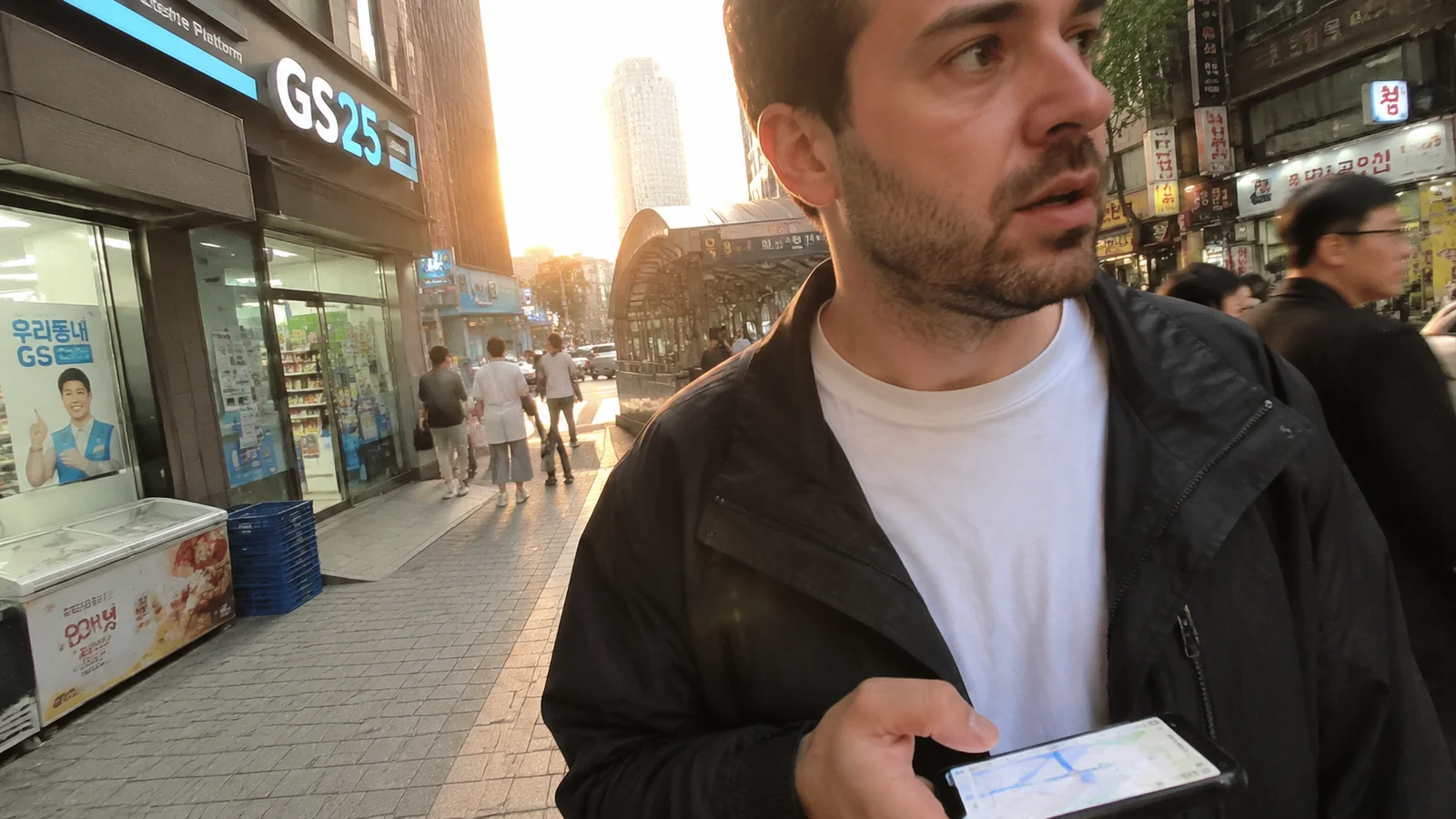
Until then, you need a physical T-money card (3,000 to 5,000 won, available at any CU, GS25, or 7-Eleven convenience store). One T-money card per person: transfer discounts do not apply when two people share one card.
Google Maps is legally broken here. Download Naver Map before you fly.
South Korea is one of the only countries where Google Maps cannot give you walking or driving directions. South Korean law restricts the export of high-precision government map data to foreign servers, which means Google’s routing engine cannot function. As The Korea Herald reported, Google Maps in Seoul will tell you it “Can’t find a way there” for any walking route, even though it provides navigation in most other countries.
Download Naver Map (and KakaoMap as a backup) before you board your flight: they are the only apps with accurate turn-by-turn walking directions, real-time bus tracking, and Korean address search in English.
Kakao Pay and Naver Pay are off-limits to tourists.
You will see locals tapping their phones at almost every register. You will not be joining them.
Both Kakao Pay and Naver Pay require a Korean resident registration number, an Alien Registration Card, and a Korean bank account, none of which a tourist can obtain on a short visit. As confirmed by Korea Navigator’s payment guide, the mobile payment apps that dominate local commerce are essentially inaccessible to short-term visitors. Your alternatives: Visa or Mastercard at mid-to-large retailers, T-money for transit and convenience stores, or WOWPASS, a prepaid card available at Incheon Airport kiosks that works as both a transit card and a shop-anywhere payment card.
There are almost no public rubbish bins, and there is a legal reason why.
Tourists frequently wander Seoul holding a coffee cup with nowhere to put it. This is not a city-planning oversight. It is the deliberate result of Korea’s pay-as-you-throw waste system, which was introduced in 1995 to stop people from dumping household rubbish in public bins and thereby avoiding the mandatory paid waste bags.
As explained by Foreigner Home’s guide, the few bins that do exist near convenience stores are for customers of those stores. The practical fix: make a small purchase at any GS25, CU, or 7-Eleven and use their bin.
The e-Arrival Card is now mandatory. Fill it in within 72 hours of landing.
From 2026, visitors to South Korea must submit an e-Arrival Card online before landing. The form replaces the old paper card handed out on planes. According to the UK Government’s May 2026 travel advisory, the card must be submitted within 72 hours of your arrival time, not earlier or it expires.
It is free, takes 3 to 5 minutes, and requires your passport number, flight details, and your accommodation address. Arriving without it will slow you through immigration.
Subway priority seats are left empty even when the carriage is full.
The pink and yellow seats at the ends of every Seoul Metro carriage are reserved for the elderly, disabled, pregnant, and injured. Korean custom holds that you leave them empty even at off-peak hours with no one nearby who needs them.
As the official Visit Seoul guide notes, about 30% of all subway seats carry this status. Sitting in one as an able-bodied tourist will draw stares and, occasionally, a direct verbal correction from an older passenger.
Public drinking is legal. Tipping is not done, anywhere.
South Korea has no open-container laws for outdoor public spaces, which makes the Han River parks a genuine evening gathering spot for locals with convenience-store beer and chicken. However, some districts near palaces and government buildings have designated alcohol-free zones marked by signage. As noted by Stripes Korea’s drinking guide, check before opening a drink outdoors in restricted areas.
On the other side of the cultural spectrum, South Korea operates a strict no-tip culture: leaving money on the table or adding a gratuity will confuse staff at virtually every restaurant, cafe, and taxi. If Reddit threads on this are consistent on one point, it is this: tipping in Korea is not expected and in some cases uncomfortable for the person receiving it.
Never pour your own drink at a group dinner.
Korean drinking etiquette holds that you pour for others and others pour for you, never for yourself. When someone older reaches for the bottle, extend your glass with two hands or one hand supported at the wrist. As described by The Soul of Seoul’s etiquette guide, refusing a pour is seen as unfriendly.
If you do not want to drink, the cleanest move is to accept the pour and keep your glass full by sipping slowly. The same two-handed rule applies when handing money to a cashier or receiving change.
Getting around and paying for things.
Use Kakao T (k.ride) for taxi bookings across all major cities. Download Naver Map for navigation and subway exit info.
Grab a T-money card for transit at any convenience store. Book KTX trains via the Korail app at least a week in advance for Seoul-Busan weekend routes.
Carry 50,000 to 100,000 won in cash for traditional markets, street food, and smaller restaurants. Withdraw from 7-Eleven or GS25 ATMs for reliable foreign card acceptance. Always pay in KRW, never in your home currency when a terminal asks, to avoid Dynamic Currency Conversion.
Apps to install before you leave.
These are the apps Reddit threads consistently recommend installing before landing in South Korea. Not the generic travel apps, but the ones that actually make a difference once you are navigating an unfamiliar transit system and ordering from a Korean-only menu.
South Korea operates a strict no-tip culture. Do not leave extra money on the table, add a gratuity to a card payment, or offer cash tips to taxi drivers or hotel staff.
If you want to express gratitude, a bow and a sincere “gamsahamnida” (thank you) is the appropriate gesture. Anyone who asks you for a tip in a tourist area is almost certainly running a scam.
Carry 50,000 to 100,000 won in cash when you land. Traditional markets, street food stalls, and smaller neighbourhood restaurants often prefer or require cash. Withdraw from 7-Eleven or GS25 ATMs for reliable foreign card processing.
Most mid-to-large restaurants, department stores, and convenience chains accept Visa and Mastercard. Google Pay does not work in Korea. Apple Pay works at many but not all locations.
Where you will actually use your eSIM in South Korea.
Six cities and regions where your mobile data will earn its keep, and what the connectivity is actually like in each one.
-
SeoulWorld-class 5G everywhere, including underground subway tunnels and station concourses. Average real-world speeds of 200 to 1,000 Mbps in central districts. All three carriers (SK Telecom, KT, LG U+) perform equally well across Gangnam, Hongdae, Itaewon, and the historic palace areas around Gyeongbokgung.
-
BusanFull 5G across beach districts including Haeundae and Gwangalli, the downtown port area, and the subway system. Gamcheon Cultural Village (steep hillside neighbourhood) has solid LTE even on narrow lanes. Strong signal throughout the Shinsegae Centum City shopping district.
-
IncheonConnected from the airport arrivals hall onward. If your eSIM is pre-activated before landing, you will have data before you clear immigration. The AREX rail link to Seoul has full 4G/5G coverage throughout the journey, both express and local trains.
-
GyeongjuSolid 4G with 5G available at major historical sites including Bulguksa Temple and Tumuli Park. No dead zones reported at the main tourist attractions. The surrounding rural areas between heritage sites are well-covered given the relatively flat terrain.
-
Jeju IslandFull 4G and 5G island-wide including the coastal highway and the main Hallasan hiking routes. The interior volcanic terrain and some deeper forest trails may dip to slower 4G but coverage does not drop entirely. All three major carriers are represented on the island.
-
Seoraksan and Gangwon ProvinceStrong coverage at the trailheads and popular viewpoints near Sokcho. Deep valley segments on technical hiking routes above 800 metres are where signal gets patchy, and SK Telecom has a slight coverage edge there over KT and LG U+. Download offline maps before heading into the backcountry.
How to choose the best eSIM for South Korea.
Choosing a South Korea plan comes down to four questions. The network here is so good that quality is rarely the deciding factor for a city trip; price, plan flexibility, and which carrier you land on matter more.
Whether you are visiting Seoul for a long weekend or spending three weeks travelling between cities, the data demands are different and so is the right plan. Our broader guide to choosing an eSIM plan covers the same questions for any destination. Below they are tuned for South Korea.
1. How much data does a South Korea trip use?
Most South Korea travellers use 1 to 2GB of data per day for standard usage: Naver Maps navigation, WhatsApp, KakaoTalk, email, and social media. Naver Maps uses more data than Google Maps because it is pulling live transit information continuously, so factor that into your daily estimate. The amount of data you need depends on your travel style and how heavily you use maps, streaming, and hotspot tethering.
Remote workers on video calls or travellers uploading large photo files should budget 3 to 5GB of data per day. Navigating Seoul by subway with real-time departures running and Papago translating menus can use 300 to 500MB per day before you account for anything else.
For a one-week South Korea trip, a 5GB to 10GB plan covers most travellers. Two weeks covering cities like Seoul and Busan: 15 to 20GB.
If you plan to use a Wi-Fi hotspot to tether a laptop, add 50% to your expected daily data usage. The unlimited plans with data from eSIMply (from $10.95) or Nomad (from $11.00) remove the mental overhead of tracking usage for heavier users.
2. Which Korean carrier does each eSIM use?
South Korea has three major mobile networks and your eSIM connects to one or more of these when you land. SK Telecom is the largest network provider in South Korea by subscriber count and has a slight edge in rural and mountain coverage.
KT Corporation (KT) and LG U+ are the other two, with all three carriers offering reliable connectivity and 5G LTE across South Korea’s major cities. For urban itineraries covering Seoul, Busan, and Jeju, the practical difference between carriers is minimal.
Of the eight providers we reviewed, Nomad is the only one routing across all three Korean carriers (SK Telecom, KT, and LG U+). Jetpac and aloSIM both disclose SK Telecom and KT. Roamless discloses SK Telecom and LG U+.
eSIMply routes through SK Telecom. Airalo offers KT for fixed-data plans, with customers using LG U+ on Airalo’s unlimited plans. Saily and GigSky both declined to name their Korean carrier partner on the product page, and where a network provider does not disclose, we say so rather than guess.
3. Capped plan or unlimited in Seoul?
For South Korea, both capped and unlimited plans work well. Coverage is excellent across the country in urban and suburban areas, so the main factor is your data usage habits rather than a coverage concern.
Unlimited plans make sense for travellers using heavy data: video calls, live streaming, extensive hotspot use, or anyone who finds tracking data a hassle. eSIMply’s unlimited plans from $10.95 / 3 days and Nomad’s from $11.00 / 3 days are both strong options.
Capped plans are often more cost-efficient for light-to-moderate users spending a week or two in South Korea. The 5GB / 30-day plans around $10 to $11 from eSIMply, Saily, or Roamless give most travellers plenty of room for maps, messaging, and social media without paying for data headroom they will never use.
4. Korea-specific eSIM or a regional Asia plan?
If South Korea is your only destination, a South Korea-specific eSIM is the right choice and is typically 20 to 35% cheaper than equivalent regional Asia plans. You can get an eSIM for South Korea without paying for Japan, Taiwan, or other countries you are not visiting.
Regional plans make financial sense when your trip takes you across multiple destinations: South Korea combined with Japan, Singapore, or other Asian countries. Two or more countries in the same trip tips the calculation toward a regional eSIM for data plan simplicity.
Install your South Korea eSIM before you board, set it as your default data line, and turn off data roaming on your home SIM to avoid surprise charges. With an eSIM, your phone connects to the Korean carrier network the moment you land at Incheon Airport. If using Naver Maps for navigation, also download offline maps for South Korea before flying.
South Korea eSIM FAQs.
Do eSIMs work in South Korea?
Yes. South Korea has some of the best mobile network infrastructure in the world, and all major eSIM providers on our list (eSIMply, Airalo, Saily, Nomad, Jetpac, aloSIM, Roamless, GigSky) offer South Korea eSIM plans that work reliably across the country.
The three Korean carriers, SK Telecom, KT, and LG U+, all provide 4G LTE and 5G coverage across Seoul, Busan, Incheon, and Jeju City. Underground coverage extends into subway tunnels and station concourses, which is rare globally. Rural mountain areas are the one exception, where deep valley trails may see reduced signal.
Buy and install your eSIM before you fly. Scan the QR code in your phone’s settings, set the eSIM as your default data line, and you will have mobile data the moment you land at Incheon Airport. The eSIM experience in South Korea is generally smooth: fast activation, reliable coverage, and no airport queue.
Is Airalo eSIM good in Korea?
Yes, Airalo offers reliable eSIM plans for South Korea. Their fixed-data plans route through KT and their unlimited plans through LG U+, both verified on the Airalo product page. When comparing a sim or esim option for Korea, Airalo is one of the most established names.
The main limitation is price: eSIMply offers lower pricing at comparable data tiers. Airalo’s 1GB / 3-day plan at $4.00 compares to eSIMply’s 1GB / 7-day plan at $2.95, for instance. Airalo’s strength is its large data buckets, with 50GB / 30 days available for heavy data users.
Reddit communities flag Airalo’s Korea unlimited plans as overpriced relative to alternatives like the Nomad eSIM or eSIMply. For standard capped plans, Airalo is a reliable option. For unlimited data, compare pricing carefully before committing.
Which SIM card is best for tourists in Korea?
A travel eSIM from an international provider (eSIMply, Airalo, Nomad, or similar) is the option that offers the best esim experience for most tourists visiting South Korea. Data packages start from $1.00 for a short stay with Jetpac or $2.95 for a week with eSIMply, which suits your travel needs without the airport queue or registration hassle. eSIM plans with unlimited data are also available from multiple providers on our list.
Physical SIMs are available at Incheon Airport telecom desks from SK Telecom, KT, and LG U+, but they cost significantly more (typically 30,000 to 40,000 KRW for a week) and require passport registration. You also cannot top up your data remotely if you run out. The queue at airport SIM desks can also take 20 to 30 minutes during peak arrival periods.
The advantage of a local physical SIM is that it includes a Korean phone number for local calls and SMS. If you need to make calls to Korean landlines or use reservation systems that require a Korean number, a local SIM may be worth the higher cost. For most tourists who rely on WhatsApp and internet access across major cities like Seoul and Busan, a travel eSIM is the better choice.
Which is better: eSIM or pocket WiFi for Korea?
A travel eSIM is almost always the better choice over pocket WiFi for South Korea. Reddit communities are consistent on this: eSIM is the standard recommendation, and pocket WiFi is rarely mentioned positively in recent threads.
The advantages of an eSIM over a pocket WiFi device: no additional hardware to carry, no risk of losing it, no charging a second device, no sharing bandwidth with travel companions, and typically lower cost for solo travellers. eSIM plans for South Korea start from $1.00 versus pocket WiFi rental from around $7 to $10 per day for a single device.
The one scenario where pocket WiFi still makes sense is travel with multiple people who need data on separate devices and are all sharing a single connection. For solo travellers or couples, an eSIM per person is generally simpler and cheaper.
Can I get a South Korea eSIM before arriving?
Yes, and this is the recommended approach. All providers in our comparison (eSIMply, Airalo, Saily, Nomad, Jetpac, aloSIM, Roamless, GigSky) sell South Korea eSIM plans you can purchase, install and activate from home before you fly.
The process takes about 5 minutes: buy a plan online, receive a QR code by email, scan it in your phone’s Settings under “Add eSIM” or “Add Mobile Plan”, and follow the prompts. Set the eSIM card as your default data line before boarding. When you land at Incheon, your eSIM connects to its Korean carrier automatically and you have a reliable internet connection immediately, with no airport desk queue and no registration paperwork.
If you forget before flying, Incheon Airport has free Wi-Fi in the arrivals hall. You can purchase and install a South Korea eSIM plan from any provider on our list using that connection within a few minutes of landing. You will be connected from the moment you clear immigration.
How much data do I need for South Korea?
Working out how much data you need for South Korea is straightforward once you know your itinerary. For a standard one-week trip, budget 1 to 2GB of data per day for typical tourist use (Naver Maps, WhatsApp, KakaoTalk, email, and social media), which is 7 to 14GB for a week. A 5GB plan covers a short Seoul-focused break; a 10GB plan is more comfortable for a week covering Seoul, Busan, and Gyeongju.
Remote workers on video calls or frequent users of mobile hotspot should plan for 3 to 5GB per day. For a two-week trip, a 20GB capped plan or an unlimited plan from eSIMply or Nomad removes the need to track data at all.
South Korea’s subway and bus apps (Naver Maps, KakaoMetro) use data continuously for real-time information, so usage can be higher than you expect on transit-heavy days. The plans with unlimited data remove that concern entirely.
Does a South Korea eSIM come with a phone number?
No, travel eSIMs for South Korea are data-only plans. They do not include a local phone number or the ability to make or receive standard cellular calls on the eSIM line. The plans are designed for internet access, not for voice.
This applies to all providers on our list. The standard setup: keep your home SIM active alongside your South Korea eSIM in the same phone. Your home number stays active for WhatsApp, calls, and 2FA verification.
The South Korea eSIM handles all your mobile data, with reliable coverage across Seoul and beyond, while you keep your number on your home SIM. Set the eSIM as your default data line in Settings and turn off data roaming on your home SIM. You can track your data usage through the mobile app provided by each provider.
Note for restaurant bookings: some popular Seoul restaurants require a Korean phone number to hold a reservation via Naver or Kakao. A data-only eSIM does not include a local phone number. Ask your accommodation to assist with bookings that require one, or visit in person for walk-in availability.
Is my phone eSIM compatible for South Korea?
Most smartphones released after 2018 support eSIM, but some exceptions exist. To check eSIM compatibility on iPhone: go to Settings, General, About and look for “eSIM” or “Available SIM” listed. On Android (operating system): Settings, Network and Internet, SIMs and look for an “Add eSIM” option, which appears in that menu if your device is compatible.
iPhones from XS onwards, Samsung Galaxy S20 and later, and Google Pixel 3 and later all support eSIM. Some Android phones sold in China ship without eSIM support even when the same model sold elsewhere includes it. Travellers from the United States should note that some US carrier-locked models need unlocking before a travel eSIM installs, so contact your home carrier to confirm before purchasing.
All South Korea eSIM data packages on our list work on any unlocked eSIM-compatible iPhone or Android phone. The eSIM installs as an embedded SIM profile in your phone settings, not as a physical SIM card, so no hardware swap is needed.
How we evaluated these South Korea eSIMs.
eSIMply is our own eSIM business, and one of the eight plans here is ours. We have written up the rest the way we would want a competitor to write about us, prices shown and carrier named where disclosed.
All eight sell an international prepaid eSIM for South Korea you can buy, install at home, and switch on when you arrive. The figures come straight from each provider’s own Korea page.
Every carrier claim in this guide traces back to a primary source: the provider’s own South Korea product page. South Korea’s three major carriers are SK Telecom, KT Corporation, and LG U+. All three operate nationwide 5G networks.
- For every eSIM provider we list, we visited each provider’s South Korea product page directly to identify which Korean carrier network they use. Nomad was the only provider disclosing all three carriers (SK Telecom, KT, LG U+). Jetpac and aloSIM disclose SK Telecom and KT.
- Roamless discloses SK Telecom and LG U+, and Airalo discloses KT for fixed-data plans and LG U+ for unlimited. eSIMply discloses SK Telecom (listed as “SK” on its plan pages). Saily and GigSky do not name their Korean carrier partner and were marked accordingly.
- We compare pricing across the full plan range, plan flexibility, validity windows, hotspot and tethering allowances, and whether unlimited data plans include daily caps or throttling.
- Where two providers share the same Korean network, we rank by price, install experience, customer support availability, and published fair-use terms.
We may earn a small commission if you buy through a link here. It does not change the order, and a weak provider stays off the list whatever the terms.
Jamie has worked in telecommunications for more than 8 years across mobile, SMS, eSIM, apps, and adjacent technology. He now writes for eSIMply as the tech content writer, analysing the top eSIM providers and breaking down what travellers actually need to know.
While we do our best to ensure accuracy, prices and plan availability are subject to change. Prices shown are approximate and may vary. Last updated by Jamie Cole, tech content writer at eSIMply.


